Exploring India's food through a chemical engineer's perspective
Every dish pinned to its place, with a recipe written for it, a health score, Ayurvedic notes, the history behind it, and the chemistry that makes it work.
Four ways in
start wherever you're hungryWander the map
Tap a state, filter by veg, Jain, vrat or fish, or follow a trail down the Grand Trunk Road.
Open the map → 02 · CookCook it tonight
Recipes scaled to your table, a step-by-step cook mode and a timer for every pot.
Pick a recipe → 03 · PlanPlan the week
Fill a week inside your cooking time; the scheduler says when to start each pot and what to buy.
Plan my week → 04 · LearnSee the science
Seventeen interactive labs, sixty-two ingredient cards and a pantry that says what you can cook.
Open a lab →Never studied chemical engineering? Start with the twelve big ideas, drawn in pencil →
One dish, five lenses
every dish page looks like thisMasala Dosa
Fermented rice-and-urad crêpe with a spiced potato filling. Udupi, Karnataka.
Also known in the atlas: Mysore masala dosa, benne dosa, set dosa, rava dosa, paper dosa.
Open this dish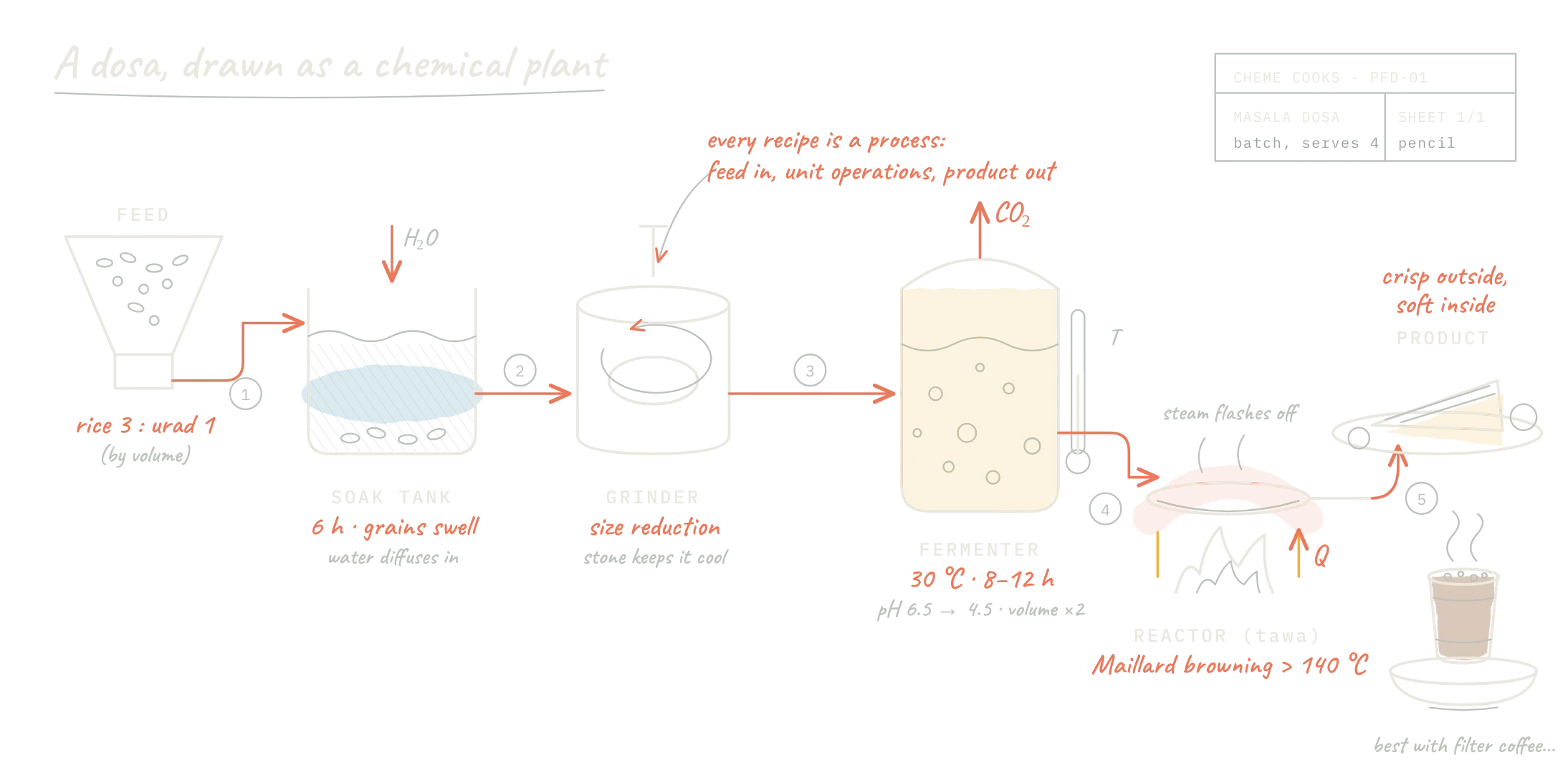
How warm is your kitchen?
Dosa and idli batter is alive. Its bacteria slow down sharply in the cold, which is why the same recipe that rises overnight in Chennai can sit flat in a winter kitchen in Chicago.
The atlas uses the same model in its meal planner, so your soak-and-ferment reminders move to match your kitchen.
The recipe's 10-hour ferment assumes a warm Indian kitchen (about 28 °C); the rate scales by the square-root rule, µ ∝ (T − 5 °C)², as in the atlas planner. Try the full lab →
Finding your way
a quick tour of the toolbarFirst time in the atlas? A five-step tour points these out, and you can replay it any time from How it works.
Kitchen science for young cooks
Twelve experiments with things already in the kitchen. Guess first, try it, then find out why.
- Turn turmeric red with baking soda
- Blow up a balloon with lemon and soda
- Make kulfi in a bag of ice and salt
About the atlas
How it was made
Created by Mohan Boggara and built with AI assistance (Claude and ChatGPT) under his direction: recipes written for the atlas, histories summarised from cited sources, and models drawn from published food-science work.
Sources and accuracy
Nutrition from USDA FoodData Central and IFCT 2017; histories link their sources on every dish. Ayurveda and Nutri-Score notes are for information, not medical advice. The map shows India's boundaries as per the Survey of India, simplified.
Open code
Code is open source under MIT; recipes, histories and sketches are CC BY-NC 4.0. Your stamps, plan and pantry stay in your own browser. Source on GitHub.